Monday, January 9, 2012

Remembering Dave Cline


Last Sunday, January 8th, would have been Dave Cline's 65th birthday. Dave died on September 14, 2007, which was far too soon and in my opinion, Dave was a belated casualty of the war in Vietnam.

Please watch this video and if you wish, you can download an abbreviated version of the entire movie from Google videos.
 
Peace and Solidarity,

Ken Dalton
VFP 21, N.J.
VVAW

"In the 1960's an anti-war movement emerged that altered the course of history. This movement didn't take place on college campuses, but in barracks and on aircraft carriers. It flourished in army stockades, navy brigs and in the dingy towns that surround military bases. It penetrated elite military colleges like West Point. And it spread throughout the battlefields of Vietnam. It was a movement no one expected, least of all those in it. Hundreds went to prison and thousands into exile. And by 1971 it had, in the words of one colonel, infested the entire armed services. Yet today few people know about the GI movement against the war in Vietnam."
Vietnam vet Dave Cline was one of those organizers.

Visit www.sirnosir.com

Thursday, December 22, 2011

Writing the Way Home


Book project supported by VFP 21

By Jan Barry

Across America, a special gift is arriving at numerous homes this week. This gift is a new book by Warrior Writers titled After Action Review: A Collection of Writing and Artwork by Veterans of the Global War on Terror.

What makes this book decidedly different from so many other gifts this holiday season is three-fold: its handcrafted artistry by young men and women who turned sleepless nights and troubled days into making art with hands that for too long held war weapons; its funding by dozens of supporters who collectively chipped in thousands of dollars to pay for the printing and postage; and its timing—published just as the war in Iraq was officially declared over and the last US military units departed that war-savaged land.

Here at home, a great many veterans of deployments in Iraq and Afghanistan are trying to turn off unrelenting war memories. Some try chasing off nightmares with hard drinking, drugs, death-defying lifestyles. Some find nothing seems to work. As Zach LaPorte, a former Army Ranger who served twice in Iraq, writes in a poem titled “Spliced”:

My life is like a slide show, spliced with images of the desert.
Mom asks me if I like the potatoes,
     A woman shrieks from a bloodied mouth.
My Professor hands me an exam paper,
     I’m riding in the door of a Blackhawk.
I walk alone at night past neon signs,
     Crimson tracers snap so close you could touch.
I sit in my air-conditioned cubicle,
     The blood in my brain boils.
The scars run deeper than they appear.

LaPorte’s poem is a troubling, yet heartening example of what the Warriors Writers project and this anthology are about: writing war images and injuries out, releasing them to the light of day, shared with those who care, aired to help heal hidden torments that long ago were called “soldier’s heart.”

"It's hard to overestimate how writing can heal long scarred over wounds that every veteran inevitably has,” Josiah White, a former Marine who was wounded by a suicide bomber, writes in a quote displayed on the back cover. “These stories and poems also have the power of communicating a near impossible message to non-veterans, those hurt by war, those hurt by tragedy, anyone who has ever suffered and asked the question ‘why?’ No one will read this book and come away unchanged."

With the 10-year war in Afghanistan still raging and flailing dangerously into Pakistan, this book raises veterans’ concerns that extend far beyond the mission in Iraq that just ended. In the Foreword, Brian Turner—author of one of the first poetry books to come out of the war in Iraq, Here, Bullet—writes that the works in this anthology “seem to suggest that we would be wise to take stock of where we are now, as a country.”

Many of the pieces in this collection by more than 60 contributors focus on an incident that triggered disconcerting change in perspective in the midst of military life. In a poem titled “Happy Birthday,” Zachariah Dean writes about suddenly realizing he just turned 26 as death whizzes by in the middle of a firefight in Afghanistan in which his rifle is jammed by a defective bullet. Scrambling to fix the rifle, it hits him how carelessly he’s led his life to end up in such a desperate jam. "I wrote this in a hurry in a machine gun turret several nights later,” he notes in the poem, stunned by the surreal experience. “Try to burn it out of memory by putting it on paper…"

Others focus on trying to find a thread that may bring deeply sought change for the better in a veteran’s life. In a sardonic welcome home for himself and other veterans, Garett Reppenhagen wrote in a poem titled “Black Out Drive”:

Heeeey, welcome home brother.”
Just grip that wheel hero.
Stay alert, stay alive.
The real war has just started,
Your fight to survive.

Jacob George, who served three tours in Afghanistan with the Army, reaches out to fellow Americans in a poem titled “Support the Troops”:

don’t thank me for what I’ve done

give me a big hug
and let me know
we’re not going to let this happen again
because we support the troops
and we’re gonna bring these wars to an end 


Unlike collections of writings by warriors of previous wars, women veterans take a prominent role in this anthology. Air Force veteran Kristina Vogt captures the bizarre military bureaucratic mumbo-jumbo that she describes as, from a female perspective, creating “the womb of the WoMD” (weapons of mass destruction)—the official reason for invading Iraq, which became as illusive as a desert mirage.

“I am the savage,” writes Emily Yates, who served two combat tours in Iraq, describing bursting into “proud homes” looking for elusive enemies, where women and children “stand in the doorway with fearful faces,” while she the armed American soldier wields “the weapon of ignorance … the shield of arrogance,” speaking with “the voice of entitlement….”

Former Army sergeant Robynn Murray, in a poem titled “Eviscerated,” throws the disillusionment of serving in terrorizing raids on Iraqi civilians directly at war supporters back home:

I am your walking wounded broken toy soldier,
and your flag is burning and all your yellow ribbons have fallen down.
I cut open these festers to force your eyes to see the truth so damn it, LOOK!
Look at what has become of me, of us.

I will gladly reopen these wounds if there is change that will come of it.
So that no one else receives these scars. …

Woven throughout the poetry and essays in this collection is an arresting gallery of often startling artwork. These include an American flag made of bullet casings (“Bullet Flag” by Lars Ekstrom); a toy soldier inside a prescription bottle (“Trapped” by Malachi Muncy); and a drawing of a walking skeleton with flaming oil derricks crowning the skull (“Greed Walks” by Eric Estenzo).

Many of the works in this book address post-traumatic stress disorder (PTSD). Chantelle Bateman, a Marine veteran of Iraq, writes about “anger is the color I sometimes paint the town with … louder than incoming and the sirens they play when I hit the deck … I’m just a pile of tears needing to punch you”. Another former Marine, Jon Turner, punches at everything in sight in Iraq and back home in a string of explosive, insightful, drunken, cold sober images of human encounters, rejections, attempts at reaching out that ends with these lines:

In the unwritten letters and poems—
are the hidden faces of war

Several pieces reach breathtakingly out of inner turmoil to find an uplifting path. “I desire to trust life,” writes former Marine Liam Madden, “to cultivate my unique and needed gifts/Loving with abandon/ I intend to weave a web of gratitude into my community.” His poem “Intention” is the first in the book, followed by a wide array of perspectives drawn from a decade of war. The last poem is called “Brio,” in which Army veteran Maggie Martin, who served twice in Iraq, joins others in various civic actions:

I sow community in re-acquisitioned places,
Crowded city street, marching orders, protest song,
Our hands and mouths’ unsinkable strength.

Old constructs crumble and blow away,
new consciousness takes root.

The concluding section showcases photos of veterans at Warrior Writers workshops in cities around the country, accompanied by a quote by Eli Wright, a former Army combat medic: "I used to write before I went to Iraq, but when I got over there, I wasn't able to write. So through Warrior Writers I have been able to slowly begin to find my words again and share my experiences and what happened over there. It's been a healing experience."

The nearly 200-page anthology was compiled and edited by Lovella Calica, the director of Warrior Writers, which is based in Philadelphia, PA, with the assistance of a number of contributors and supporters. I aided the project as an advisor and copy editor. The book was artfully designed by Rachel McNeill, an Army veteran who included thought-provoking photos shot on patrols in Iraq by herself and others. A series of drawings and paintings titled “Dust Works” by Army National Guard veteran Aaron Hughes provides a visual theme of roads through war on the cover and throughout the book.

After Action Review (paperback, $20) is the third in a series of anthologies of writing and art by Iraq and Afghanistan veterans published by Warrior Writers, and is available at www.warriorwriters.org.

VFP Chapter 21 contributed to the financial support for this book project.

Sunday, December 18, 2011

Happy Holidays


PEACE ON EARTH

Artwork on this greeting card was designed by Walt Nygard, a fellow Vietnam veteran; typesetting on the back is by Eli Wright, an Iraq war vet. 
The cards were handmade and printed by Walt, Eli and me at the Printmaking Center 
of New Jersey as part of a Combat Paper workshop.

Wednesday, November 16, 2011

Planting a Peace Pole

Jules Orkin and Puffin Peace Pole


Dedicating a Peace Pole at a community cultural center in Teaneck, NJ drew a small crowd of local officials, school children and war veterans the other day.

The carved wood pole was dedicated at the Puffin Foundation, as a band from Thomas Jefferson Middle School played and adults took turns exhorting the students and a television audience via a cable news program to help advance a cause that is often hard to hear in a nation engaged in seemingly perpetual war in various corners of the world.

“A world without war is a universal desire by untold millions of people,” Puffin Foundation Executive Director Gladys Miller-Rosenstein said on behalf of herself and her husband Perry Rosenstein, a retired industrialist and noted philanthropist. “We have sought to have our voices for peace heard. We have erected a ‘Peace Pole’ on our property. This pole will be shared by many young and old, who will take part in the varied cultural activities at our Forum. … There are presently 264 peace sites throughout New Jersey. We are proud to be one of the new sites in our state.”

“This is a community peace pole,” added Neil Rosenstein, vice president of the Puffin Foundation. “Peace is only achieved through community.” One of the community leaders, School Superintendent Barbara Pinsak, praised the Rosensteins—whose foundation assists local and regional arts programs, conservation and environmental education programs, as well as social action and investigative journalism projects—as role models. 

“This is one of the things I am very proud to welcome to Teaneck,” said state Senator Loretta Weinberg, a well-known champion for a substantial agenda of domestic issues. “May peace prevail on Earth,” she said, quoting the message on the pole, which is printed in eight languages. “It is not an easy goal. It’s a long struggle.”

The idea of planting a peace pole at the Puffin Foundation, which hosts an eclectic collection of outdoors sculpture, was proposed by Jules Orkin, a member of Veterans For Peace, Chapter 21 New Jersey. A retired bookstore owner from neighboring Bergenfield, Orkin was named a Puffin Peace Fellow earlier this year in recognition of his participation in numerous peace walks, vigils and civil disobedience actions in protest of the current wars in Iraq and Afghanistan.

In his comments, Orkin proposed organizing “a walk between peace poles,” such as the annual walk in neighboring Leonia between peace poles at the high school and the Methodist Church to mark the United Nations International Day of Peace. And then he was off to pack for a peace walk from Atlanta, Georgia to Ft. Benning, Georgia to protest the training program based there for military officers from Latin American nations that until recently were bastions of military dictatorships.

Walt Nygard, vice president of Veterans For Peace Chapter 21, spoke about transforming Veterans Day to the original, peacemaking intent of Armistice Day.   

Township Councilwoman Barbara Toffler offered an historic note of hope for peaceful change in the world. “There is a legacy of peace in Teaneck,” she said, holding up a copy of Teaneck High School’s 1959 yearbook. “The Class of 1959 dedicated its yearbook to peace,” she said, reading from that dedication, composed amid the Cold War nuclear missile stand-off with the Soviet Union by students who were born during World War II.

Peace Poles grew out of a project of The World Peace Prayer Society that began in Japan in 1955 as a response to the atomic bombings of Hiroshima and Nagasaki.

For more information:


Friday, November 11, 2011

Peace Is Patriotic


Walt Nygard at Peace Pole dedication
Comments by VFP Chapter 21 Vice President Walt Nygard, US Marine Corps veteran of Vietnam war,  at dedication of the Puffin Peace Pole at Puffin Cultural Center, Teaneck, NJ on 11/9/11.

Friday is Armistice Day.  Originally meant to honor American soldiers killed in World War I, it was a celebration - of sorts - of the peace that had arrived at the end of the War to End All Wars.  Since then, Veterans Day has become a day to honor succeeding generations of American veterans, as the idea of lasting peace was never seriously pursued by the governments of the world or their various owners.

 The day itself all too often becomes a spectacle of militarism and bogus patriotism.  Spewed by politicians and businessmen who've never heard a shot fired in anger, patriotism - like Armistice Day itself - is now held hostage by those untroubled by the idea of endless war.

 Their words mean nothing.  History will record who the patriots were.  Our bloody Twentieth Century has now passed away.  We are at a time and place of change and so that when our history is written, the stories of Joe Hill and Gene Debs and Woody Guthrie will be as one with those of Alvin York and Audie Murphy and John Basilone.  

The struggle for peace is surely fighting for one's country.  Peace is patriotic.  Keep up the fight!

Friday, October 28, 2011

The War at Home

Scott Olsen (photo/AP)

In Boston, Massachusetts and Oakland, California, Veterans For Peace members have been assaulted by police while peacefully demonstrating on behalf of Occupy Wall Street protest groups’ constitutional rights.

The most seriously injured is Scott Olsen, a Marine vet of two tours in Iraq, who was hospitalized with head injuries after police in Oakland fired tear-gas canisters and other projectiles into an Occupy Oakland crowd assembled in front of City Hall. Olsen was wearing a Veterans For Peace T-shirt and desert camouflage field jacket and hat when he was struck in the forehead. He is also a member of Iraq Veterans Against the War.

“It was like a war zone,” Joshua Shepherd, a fellow vet who was standing near Olsen while dressed in his Navy uniform and holding aloft a highly visible, white Veterans For Peace flag, told The Associated Press. “Shepherd said it’s a cruel irony that Olsen is fighting for his life in the country that he fought to protect. ‘He was over there protecting the rights and freedoms of America and he comes home, exercises his freedoms and it’s here where he’s nearly fatally wounded,’ Shepherd said.”

In Boston, police knocked down, clubbed and tore Veterans For Peace and an American flag from the hands of a group of peace activist vets standing between the police assault and an Occupy Boston encampment the authorities set out to destroy. Among those dragged off to a paddy wagon was Rachel McNeil, an Army vet who served in Operation Iraqi Freedom and was holding an American flag. Her crime: “Rachel loudly and continuously led a chant of the Oath (I do solemly swear to uphold and defend the Constitution of the United States of America against all enemies foreign and domestic); but she alternated it with ‘We have a permit.  It's called the Constitution’ and also ‘This is a peaceful demonstration,”" a fellow Vets For Peace member noted.

Rachel McNeil (right) and fellow VFP members
“VFP members are involved with dozens of these local ‘occupy movement’ encampments and we support them fully,” VFP national officers stated.  “In Boston, for example, our members, wearing VFP shirts and carrying VFP flags, stood between a line of police and the encampment, urging police to ‘join the 99%’ and not evict the protesters.  In that case, several of our members were banged and bruised when the police decided instead to carry out their eviction orders…
“As with virtually every example of the occupy movement across the country, those encamped were conducting themselves peacefully beforehand, protesting current economic, social and environmental conditions in the U.S. brought about by decades of corporate control, a criminal financial industry and wars in Iraq and Afghanistan that are driving the U.S. global empire into bankruptcy.  These ‘occupy movement’ participants are telling us something we need very desperately to hear.  They should be listened to, not arrested and brutalized.

“Police in the majority of cities are acting with restraint and humanity towards the encampments, but Veterans For Peace will not be deterred by police who choose to use brutal tactics.  In fact, as happens with repression everywhere, more people join the cause.”    

Indeed, as The New York Times reported today, “the wounding of an Iraq war veteran … has provided a powerful central rallying point.” Thousands of people streamed into downtown Oakland the next day for a peaceful gathering on behalf of the Occupy Oakland movement. The mayor of Oakland commended the movement’s goals. The police promised an investigation into what caused Olsen’s injuries. News reports and videos taken at the time show what happened.

“ Scott Olsen, a 24-year-old Marine who served two tours of duty in Iraq, stood calmly in front of a police line as tear gas canisters that officers shot into the Occupy Oakland protest Tuesday night whizzed past his head,” the San Francisco Chronicle reported today.

"’He was standing perfectly still, provoking no one,’ said Raleigh Latham, an Oakland filmmaker shooting footage of the confrontation between police and hundreds of protesters at 14th Street and Broadway. ‘If something didn't hit him directly in the face, then it went off close to his head and knocked him down.’ The something was a projectile that apparently came from police lines, fractured Olsen's skull and put him in Highland General Hospital. Doctors upgraded his condition Thursday from critical to fair, and said they expect him to make a full recovery.”

Like many members of Vets For Peace, Scott Olsen felt it was important to demonstrate the peaceful presence of military veterans at the Occupy Wall Street encampments that have sprung up around the country. As The Associated Press noted in a report carried by Business Week and news publications nationwide, Olsen “makes a good living as a network engineer and has a nice hillside apartment overlooking San Francisco Bay. And yet, his friends say, he felt so strongly about economic inequality in the country that he fought for that he slept at a San Francisco protest camp after work.

"’He felt you shouldn't wait until something is affecting you to get out and do something about it,’ said friend and roommate Keith Shannon, who served with Olsen in Iraq.”


Sunday, October 9, 2011

Protest at Wall Street

Ken Dalton (center) holds VFP banner at Wall St. protest

A contingent of Veterans For Peace Chapter 21 and Military Families Speak Out members from New Jersey joined the Occupy Wall Street demonstration on Saturday, October 8.

Many in the crowd of young people, older folks who dusted off memories of the protests of the '60s and '70s, and photo-snapping tourists seemed delighted to see the VFP banner unfurled near a corner of Liberty Plaza facing the new office towers being constructed at the site of the former World Trade Center. Among the Jersey contingent was VFP Chapter 21 President Ken Dalton, a Navy vet of the Vietnam war, who worked as a fire fighter in search and rescue operations at Ground Zero in the wake of the Sept. 11, 2001 attack.

A common question of news reporters who stopped by for a comment was “What do war and Wall Street have in common?” Duh. Millions of unemployed veterans and other folks caught in the web of trillion-dollar wars and an economic collapse that the federal bailout of Wall Street banks was supposed to fix could have told them in a New York minute.

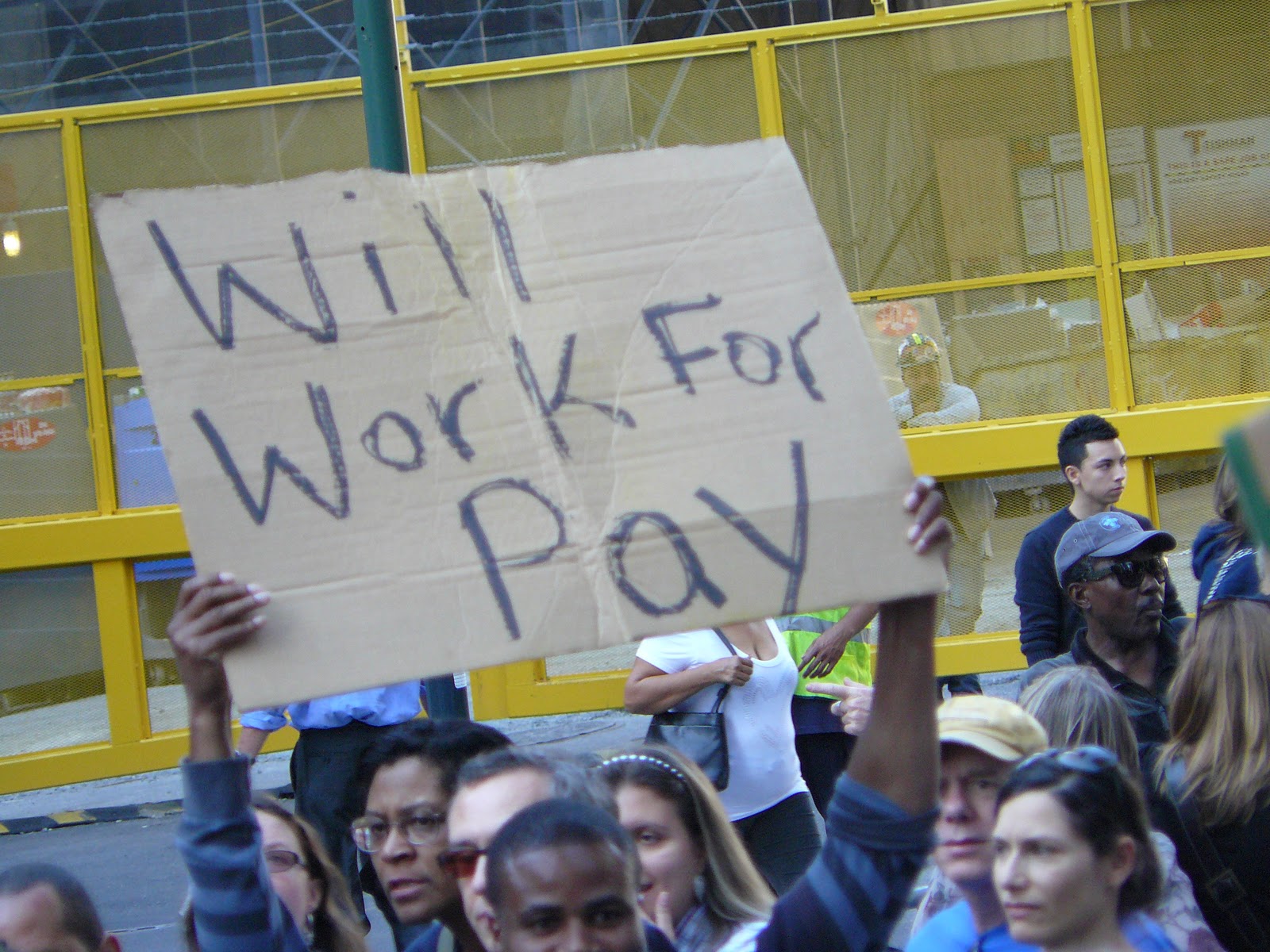
Many of the demonstrators in New York on Saturday eloquently stated the reasons for their dismay in an array of hand-made signs, some of which are shown here.

(Photos by Jan Barry)