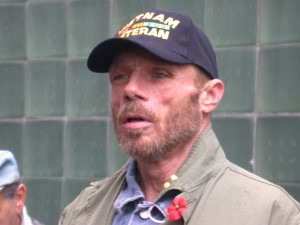
Three-fourths of the VFP Executive Committee arrested along with others in DC today
Dear Colleagues,
VFP President Mike Ferner, Vice President Leah Bolger, and Treasurer Ken Mayers were all arrested in front of the White House today while standing vigil over three mock coffins draped with US, Afgan, and Iraq flags. Other VFP members arrested included Mike Hearington, Jim
Goodnow, Tarak Kauf, Tom Palombo and Louis Wolf. VFP Executive Director Michael McPhearson, along with Colonel Ann Wright and members of the capital area VFP chapters also supported the protest. The VFP members were among 65 arrestees who included Kathy Kelly, Liz McAlister, and Cindy Sheehan among others. All those arrested were taken to the National Park Police Headquarters, booked, and released. They now have 14 days in which to reappear at the National Park Police Headquarters either to pay their $100 fines or to obtain a court date.
Along with Veterans for Peace, a broad range of affinity groups, such as the Atlantic Life Community, Witness Against Torture, Veterans for Peace, World Can’t Wait, and Activist Response Team had members arrested. Other groups fully endorsing the action and participating were Peace Action, Code Pink, the War Resisters’ League, and Student
Peace Action Network.
The protest called for withdrawal of all U.S. troops from Afghanistan, ending the illegal bombing with US drones, including neighboring Pakistan, and the closing of the Bagram prison and ending indefinite detention and torture. We called for an end to these wars and
occupations, including that of Iraq, so that our resources can be used for life-sustaining actions including the funding and the rebuilding of Afghanistan’s and Iraq’s infrastructure and medical assistance to Afghans and Iraqis, in addition to poverty reduction programs in the United States and world wide. We continue to call for accountability for those who have committed war crimes.
Kenneth Mayers
Veterans for Peace - Santa Fe
Wage Peace!
Monday, October 5, 2009
Monday, August 24, 2009
Convention '09
Sunday, August 23, 2009
Convention '09
". . . the best people and
the stoutest souls in the world . . ."
- Mike Ferner
Never been to a convention before. Heard about 'em often enough; I'd formed a few opinions: a large gathering of people from around the country (or state or world), a lotta speechs and meetings, funny hats and boisterous behavior, good opportunity to meet, drink, push agendas, settle scores, pick up bumperstickers, act like a fool . . . I was filled with prejudices and misconceptions.
But I'd been scorched by the emotional intensity of the Winter Soldier Hearings, March 13-16, 2008. As Security volunteer, I found myself part of the biggest and truest thing happening in America those four days. My particular job was small and anonymous, but I walked with heroes those days. My life was changed in ways marchs and vigils, signs and slogans could not match.
So I went to the Convention for the fellowship . . . and maybe to read a few poems. In a time when even political victory doesn't seem good enough, I went to rekindle my spirit, revive my dedication. I went looking for those heroes.
And in the hallways and meeting rooms, the food court and lit room, I found them . . . guys like Paul Brailsford, Englishman, Massachusetts VFP, activist and poet, who went to sea in 1932 at age 16, stood the lonely watchs as a deck officer in the Pacific during World War II and at age 93 remains a stalwart voice for peace and justice . . . and Suel Jones the Marine rifleman from Texas and the Vietnam War, who now divides his time between Alaska and Vietnam, went from oilfield machinist to gifted memoirist and friend to the Vietnamese people . . . and the service brats: Deborah Forter, Navy, M.F.S.O.'s new leader and Donna Edwards, Air Force, Maryland's new Congresswoman. Dragged around the world as service kids are, these eloquent women learned at an early age to love the warrior and hate the war . . . and everywhere I turned, there was Carlos - just like at Winter Soldier - a curly-haired Saint Everyman, tirelessly holding heaven and earth together, his presence our whole meaning, his tragedy our fight . . .
The names and faces go on and on, anchored by a corps of Vietnam veterans and their good spouses, enriched by those of other eras and re-affirmed by the strong, young faces of the men and women of the Afghan and Iraq Wars.
Days later, outside the Teaneck Armory, at our four year old vigil, Chapter 21 Prez Ken Dalton regaled the watchstanders with tales of conventions and conventions to come. Ken once lived up in Portland, Maine, had , like the rest of us - Nancy and Paula, Barry, Fallon, Hancock, the Drozds - a great time at '09. I interrupted him to ask, what's Portland, driving time from Jersey? 'Bout six hours. Next year I thought. Sounds good.
- Walt Nygard August 23, 2009
Convention '09
". . . the best people and
the stoutest souls in the world . . ."
- Mike Ferner
Never been to a convention before. Heard about 'em often enough; I'd formed a few opinions: a large gathering of people from around the country (or state or world), a lotta speechs and meetings, funny hats and boisterous behavior, good opportunity to meet, drink, push agendas, settle scores, pick up bumperstickers, act like a fool . . . I was filled with prejudices and misconceptions.
But I'd been scorched by the emotional intensity of the Winter Soldier Hearings, March 13-16, 2008. As Security volunteer, I found myself part of the biggest and truest thing happening in America those four days. My particular job was small and anonymous, but I walked with heroes those days. My life was changed in ways marchs and vigils, signs and slogans could not match.
So I went to the Convention for the fellowship . . . and maybe to read a few poems. In a time when even political victory doesn't seem good enough, I went to rekindle my spirit, revive my dedication. I went looking for those heroes.
And in the hallways and meeting rooms, the food court and lit room, I found them . . . guys like Paul Brailsford, Englishman, Massachusetts VFP, activist and poet, who went to sea in 1932 at age 16, stood the lonely watchs as a deck officer in the Pacific during World War II and at age 93 remains a stalwart voice for peace and justice . . . and Suel Jones the Marine rifleman from Texas and the Vietnam War, who now divides his time between Alaska and Vietnam, went from oilfield machinist to gifted memoirist and friend to the Vietnamese people . . . and the service brats: Deborah Forter, Navy, M.F.S.O.'s new leader and Donna Edwards, Air Force, Maryland's new Congresswoman. Dragged around the world as service kids are, these eloquent women learned at an early age to love the warrior and hate the war . . . and everywhere I turned, there was Carlos - just like at Winter Soldier - a curly-haired Saint Everyman, tirelessly holding heaven and earth together, his presence our whole meaning, his tragedy our fight . . .
The names and faces go on and on, anchored by a corps of Vietnam veterans and their good spouses, enriched by those of other eras and re-affirmed by the strong, young faces of the men and women of the Afghan and Iraq Wars.
Days later, outside the Teaneck Armory, at our four year old vigil, Chapter 21 Prez Ken Dalton regaled the watchstanders with tales of conventions and conventions to come. Ken once lived up in Portland, Maine, had , like the rest of us - Nancy and Paula, Barry, Fallon, Hancock, the Drozds - a great time at '09. I interrupted him to ask, what's Portland, driving time from Jersey? 'Bout six hours. Next year I thought. Sounds good.
- Walt Nygard August 23, 2009
Tuesday, August 11, 2009
Recruiting for Peace
By Jan Barry
Suel D. Jones is on an unusual mission. The 60-ish Vietnam vet, who hails from Texas and has a hideaway cabin in Alaska, wants to create a Veterans For Peace chapter in Hanoi. “I already got 10 members,” Jones said last week as he talked up his latest campaign, while hawking copies of his memoir, Meeting the Enemy: A Marine Goes Home, at the 24th national convention of Veterans For Peace.
In his memoir, Jones wrote: “At a Veterans For Peace convention in 2006, I was asked about how I was recruited into the Marine Corps. I replied that I didn’t have to be recruited. My parents, the church, and society had recruited me since birth.” After years of wrestling with rage he brought home from the war, Jones moved to Vietnam and did volunteer work with the Vietnam Friendship Village, a hospital for children and Vietnamese veterans affected by Agent Orange, the chemical defoliant used by the US military to destroy much of the forests in Vietnam. “I felt that as a warrior I was not complete until I returned to the country where I had fought in order to help heal the wounds of the war,” he added.
At a nearby table, Marine vet Doug Zachary of Austin, Texas, was selling a variety of books, buttons and bumper stickers on peace themes, including War Is a Racket by Smedley D. Butler, the legendary Marine major general and two-time winner of the Medal of Honor. Among the most popular items for men and women who stopped by between workshops on conflict resolution and other aspects of peacemaking were olive drab T-shirts emblazoned with the Veterans For Peace logo—a white dove on a military helmet—and an unusual team spirit message: “Recruiting for Peace.”
The event at the University of Maryland also drew Master Sergeant (ret.) Wesley Davey. A draftee during the Vietnam war, Davey ended up in Iraq with an Army Reserve unit at age 54. He arrived in College Park on a dual mission. A founder of the Minnesota chapter of Iraq Veterans Against the War, Davey is also challenging the official “don’t ask, don’t tell” policy that discriminates against gays in the military. “I was against this war, but felt that as the first sergeant I should deploy to Iraq to look out for the good people in my unit,” Davey told an assembled gathering of antiwar activists with ties to the military.
In a news article in the Minneapolis Star Tribune in 2007, Davey bluntly said: “For the second time in my life, a president has plunged our country into a quagmire where there is no way to win a victory which can be defined. I thought we learned a lesson in Vietnam. I was wrong.”
Another participant was a mother of a young war veteran who attended a workshop on poetry for peace. “My son has several poems in this anthology,” said Tina Richards, a Missouri member of Military Families Speak Out, waving a copy of “Warrior Writers: Re-Making Sense,” a collection of poetry and art by members of Iraq Veterans Against the War. Writing and reading poems on the war at antiwar events was a great help to her son, who was struggling to cope with severe health problems after two tours with the Marines in Iraq. When requests to the VA and traditional veterans’ organizations for assistance proved fruitless, Richards said she found Veterans For Peace on the Internet.
“I called my son and said ‘we’re going on a march to New Orleans,’” joining a protest march by veterans’ peace groups in 2006 through hurricane-ravaged towns awaiting federal assistance while billions of dollars were spent on waging war in Iraq. During an evening of songs and poetry by participants, her son got up, she recalled, and read a poem he’d jotted down on a napkin. And now he’s a published poet, Cloy Richards, with a growing family of his own and a future he couldn’t see through the pain before.
The veterans’ convention in a Maryland suburb of Washington, DC, drew scores of people from across the United States. It also drew one of the newest members of Congress. “It is important to hear a voice for peace. We who are working for peace have to open up the space for people to move in that direction,” said Rep. Donna Edwards (D-Maryland), who was elected last year. “I think that the work you do as veterans working for peace gives the rest of us validation for what we do,” she added.
In her keynote speech, Edwards noted that she grew up in a career Air Force family and lost her brother at age 27 as a result of “psychological problems” from his military service. “I feel that I, as a very strong opponent of the war in Iraq and in Afghanistan, am a great patriot,” she said. Yet in working to change these policies, activists need to “work for peace with respect” for other people’s perspectives, she advised. Noting that she went on a tour of Afghanistan with other members of Congress, she concluded that the US strategy of widening the war with more troops “will not work. I’m a big supporter of President Obama. But I disagree with him on this.”
Summing up the focus of the convention, Michael T. McPherson, executive director of Veterans for Peace and a Gulf War I veteran, wrote in the program book that “We must reach out and educate about the full horrors and impact of war. … We must provide and live alternatives to war. We must become examples of conflict resolution in all aspects of our lives and build solidarity with allies in search of justice. … This weekend we gather to gain strength and learn from each other to do that work.”
For more information:
http://www.veteransforpeace.org/
http://www.ivaw.org/
http://www.mfso.org/
Suel D. Jones is on an unusual mission. The 60-ish Vietnam vet, who hails from Texas and has a hideaway cabin in Alaska, wants to create a Veterans For Peace chapter in Hanoi. “I already got 10 members,” Jones said last week as he talked up his latest campaign, while hawking copies of his memoir, Meeting the Enemy: A Marine Goes Home, at the 24th national convention of Veterans For Peace.
In his memoir, Jones wrote: “At a Veterans For Peace convention in 2006, I was asked about how I was recruited into the Marine Corps. I replied that I didn’t have to be recruited. My parents, the church, and society had recruited me since birth.” After years of wrestling with rage he brought home from the war, Jones moved to Vietnam and did volunteer work with the Vietnam Friendship Village, a hospital for children and Vietnamese veterans affected by Agent Orange, the chemical defoliant used by the US military to destroy much of the forests in Vietnam. “I felt that as a warrior I was not complete until I returned to the country where I had fought in order to help heal the wounds of the war,” he added.
At a nearby table, Marine vet Doug Zachary of Austin, Texas, was selling a variety of books, buttons and bumper stickers on peace themes, including War Is a Racket by Smedley D. Butler, the legendary Marine major general and two-time winner of the Medal of Honor. Among the most popular items for men and women who stopped by between workshops on conflict resolution and other aspects of peacemaking were olive drab T-shirts emblazoned with the Veterans For Peace logo—a white dove on a military helmet—and an unusual team spirit message: “Recruiting for Peace.”
The event at the University of Maryland also drew Master Sergeant (ret.) Wesley Davey. A draftee during the Vietnam war, Davey ended up in Iraq with an Army Reserve unit at age 54. He arrived in College Park on a dual mission. A founder of the Minnesota chapter of Iraq Veterans Against the War, Davey is also challenging the official “don’t ask, don’t tell” policy that discriminates against gays in the military. “I was against this war, but felt that as the first sergeant I should deploy to Iraq to look out for the good people in my unit,” Davey told an assembled gathering of antiwar activists with ties to the military.
In a news article in the Minneapolis Star Tribune in 2007, Davey bluntly said: “For the second time in my life, a president has plunged our country into a quagmire where there is no way to win a victory which can be defined. I thought we learned a lesson in Vietnam. I was wrong.”
Another participant was a mother of a young war veteran who attended a workshop on poetry for peace. “My son has several poems in this anthology,” said Tina Richards, a Missouri member of Military Families Speak Out, waving a copy of “Warrior Writers: Re-Making Sense,” a collection of poetry and art by members of Iraq Veterans Against the War. Writing and reading poems on the war at antiwar events was a great help to her son, who was struggling to cope with severe health problems after two tours with the Marines in Iraq. When requests to the VA and traditional veterans’ organizations for assistance proved fruitless, Richards said she found Veterans For Peace on the Internet.
“I called my son and said ‘we’re going on a march to New Orleans,’” joining a protest march by veterans’ peace groups in 2006 through hurricane-ravaged towns awaiting federal assistance while billions of dollars were spent on waging war in Iraq. During an evening of songs and poetry by participants, her son got up, she recalled, and read a poem he’d jotted down on a napkin. And now he’s a published poet, Cloy Richards, with a growing family of his own and a future he couldn’t see through the pain before.
The veterans’ convention in a Maryland suburb of Washington, DC, drew scores of people from across the United States. It also drew one of the newest members of Congress. “It is important to hear a voice for peace. We who are working for peace have to open up the space for people to move in that direction,” said Rep. Donna Edwards (D-Maryland), who was elected last year. “I think that the work you do as veterans working for peace gives the rest of us validation for what we do,” she added.
In her keynote speech, Edwards noted that she grew up in a career Air Force family and lost her brother at age 27 as a result of “psychological problems” from his military service. “I feel that I, as a very strong opponent of the war in Iraq and in Afghanistan, am a great patriot,” she said. Yet in working to change these policies, activists need to “work for peace with respect” for other people’s perspectives, she advised. Noting that she went on a tour of Afghanistan with other members of Congress, she concluded that the US strategy of widening the war with more troops “will not work. I’m a big supporter of President Obama. But I disagree with him on this.”
Summing up the focus of the convention, Michael T. McPherson, executive director of Veterans for Peace and a Gulf War I veteran, wrote in the program book that “We must reach out and educate about the full horrors and impact of war. … We must provide and live alternatives to war. We must become examples of conflict resolution in all aspects of our lives and build solidarity with allies in search of justice. … This weekend we gather to gain strength and learn from each other to do that work.”
For more information:
http://www.veteransforpeace.org/
http://www.ivaw.org/
http://www.mfso.org/
Saturday, May 9, 2009
2009 VFP National Convention
The 24th Veterans For Peace National Convention is Aug. 5 – 9 at the University of Maryland in College Park, MD. Come for a day of workshops ($75), two days of workshops ($150) or the full program ($200, if register by June 1). To register, go to http://www.vfpnationalconvention.org/.
Workshop topics include GI Rights and GI Advocacy, Counter Recruiting, Torture, War Profiteering, Winter Soldier hearings, Women’s Voices, Vets 4 Vets, VFP’s Mission and many more. Learn how, as veterans, we can do more to address the widening war in Afghanistan/Pakistan, as well as the war in Iraq that is supposed to be winding down.
At the 2008 Convention, VFP passed a resolution calling for: “the government of the United States to immediately withdraw all military and intelligence forces from Afghanistan and Pakistan; to provide humanitarian aid directly to the people of Afghanistan, in non-coercive forms, to help the Afghan people rebuild their own nation and their lives in cooperation with other nations in the region; and to allow the people of Afghanistan to freely determine their own government without interference by the US.”
Workshop topics include GI Rights and GI Advocacy, Counter Recruiting, Torture, War Profiteering, Winter Soldier hearings, Women’s Voices, Vets 4 Vets, VFP’s Mission and many more. Learn how, as veterans, we can do more to address the widening war in Afghanistan/Pakistan, as well as the war in Iraq that is supposed to be winding down.
At the 2008 Convention, VFP passed a resolution calling for: “the government of the United States to immediately withdraw all military and intelligence forces from Afghanistan and Pakistan; to provide humanitarian aid directly to the people of Afghanistan, in non-coercive forms, to help the Afghan people rebuild their own nation and their lives in cooperation with other nations in the region; and to allow the people of Afghanistan to freely determine their own government without interference by the US.”
Home for Veterans
By Jan Barry
Coming home for some war veterans means slipping off the track of chasing a fading American dream. Despite the yellow ribbons of support for the troops festooning patriotic front yards and backs of cars, there’s an army of homeless former soldiers seeking shelter in cities and towns across this country. Compounding the shock of becoming homeless can be another bitter discovery: Few communities provide programs to help veterans who hit a rough patch get back on their feet. Consequently, an estimated 154,000 veterans are homeless on any given night, according to the US Department of Veterans Affairs.
Why are so many once-able military troops living a hobo life straight out of bleak stories from the Great Depression? Besides the “factors affecting all homelessness -- extreme shortage of affordable housing, livable income, and access to health care -- a large number of displaced and at-risk veterans live with lingering effects of Post Traumatic Stress Disorder and substance abuse, compounded by a lack of family and social support networks,” says the National Coalition for Homeless Veterans web site. While the VA assists about one-third of the homeless vets, the majority have to look for state and local programs.
“The most effective programs for homeless and at-risk veterans are community-based, nonprofit, ‘veterans helping veterans’ groups,” says the National Coalition for Homeless Veterans. “Programs that seem to work best feature transitional housing with the camaraderie of living in structured, substance-free environments with fellow veterans who are succeeding at bettering themselves. … There are about 250 community-based veteran organizations across the country that have demonstrated impressive success reaching homeless veterans. These groups are most successful when they work in collaboration with federal, state and local government agencies, other homeless providers, and veteran service organizations.”
When an empathetic religious group in a suburban New Jersey town proposed turning an empty church into apartments for homeless veterans, however, neighbors turned out to vehemently oppose the plan. What happened next showed the other side of America. When the proposal came up for a vote by the Highland Park Board of Adjustment recently, the room was packed by a crowd of veterans wearing military caps, peace activists in protest T-shirts, church members and residents of the central New Jersey area appalled by the neighbors’ complaints.
“Joe Vanliew broke down as he uttered his first words to the Highland Park zoning board, one of dozens of people who spoke Monday at a tense, four-hour meeting at which the board ultimately agreed to allow a shuttered church to be converted into an 11-unit housing complex for homeless veterans,” The Star-Ledger correspondent reported. "’I hope the sacrifices of every veteran are remembered tonight,’ the white-haired man said, his voice cracking. ‘They were in the thick of things, and I can't believe that anybody in Highland Park or anywhere else wouldn't support the veterans.’"
The objecting neighbors, who included a veteran or two, maintained that the conversion would add traffic to a busy street, ruin an historic building and put veterans in substandard basement-level apartments that, paradoxically, would cost much more in government grants than would be needed to buy houses on the market.
During the hearing, testimony was provided that the housing plan had the approval of federal agencies seeking to address the fact that “New Jersey has more than 3,500 homeless veterans, according to Victor Carlson, a psychologist and chief of homeless services for the Department of Veterans Affairs New Jersey Health Care System,” The Star-Ledger reported.
The veterans’ home project was launched by Highland Park Reformed Church pastor Seth Kaper-Dale, who told the newspaper that “the project stemmed from years of preaching about the wars in Iraq and Afghanistan. Members of his congregation would ask him to pray for nieces and nephews going to war, then they asked him once again to join them in prayer when the veterans returned, he said. ‘They were praying for their nephew who came back and was sleeping on someone's couch.’"
For more information:
http://www.nchv.org/
http://www.nj.com/news/mustsee/index.ssf/2009/04/highland_park_agrees_to_conver.html
http://www.mainstreethp.org/polDoc.cfm?Doc_Id=590
Coming home for some war veterans means slipping off the track of chasing a fading American dream. Despite the yellow ribbons of support for the troops festooning patriotic front yards and backs of cars, there’s an army of homeless former soldiers seeking shelter in cities and towns across this country. Compounding the shock of becoming homeless can be another bitter discovery: Few communities provide programs to help veterans who hit a rough patch get back on their feet. Consequently, an estimated 154,000 veterans are homeless on any given night, according to the US Department of Veterans Affairs.
Why are so many once-able military troops living a hobo life straight out of bleak stories from the Great Depression? Besides the “factors affecting all homelessness -- extreme shortage of affordable housing, livable income, and access to health care -- a large number of displaced and at-risk veterans live with lingering effects of Post Traumatic Stress Disorder and substance abuse, compounded by a lack of family and social support networks,” says the National Coalition for Homeless Veterans web site. While the VA assists about one-third of the homeless vets, the majority have to look for state and local programs.
“The most effective programs for homeless and at-risk veterans are community-based, nonprofit, ‘veterans helping veterans’ groups,” says the National Coalition for Homeless Veterans. “Programs that seem to work best feature transitional housing with the camaraderie of living in structured, substance-free environments with fellow veterans who are succeeding at bettering themselves. … There are about 250 community-based veteran organizations across the country that have demonstrated impressive success reaching homeless veterans. These groups are most successful when they work in collaboration with federal, state and local government agencies, other homeless providers, and veteran service organizations.”
When an empathetic religious group in a suburban New Jersey town proposed turning an empty church into apartments for homeless veterans, however, neighbors turned out to vehemently oppose the plan. What happened next showed the other side of America. When the proposal came up for a vote by the Highland Park Board of Adjustment recently, the room was packed by a crowd of veterans wearing military caps, peace activists in protest T-shirts, church members and residents of the central New Jersey area appalled by the neighbors’ complaints.
“Joe Vanliew broke down as he uttered his first words to the Highland Park zoning board, one of dozens of people who spoke Monday at a tense, four-hour meeting at which the board ultimately agreed to allow a shuttered church to be converted into an 11-unit housing complex for homeless veterans,” The Star-Ledger correspondent reported. "’I hope the sacrifices of every veteran are remembered tonight,’ the white-haired man said, his voice cracking. ‘They were in the thick of things, and I can't believe that anybody in Highland Park or anywhere else wouldn't support the veterans.’"
The objecting neighbors, who included a veteran or two, maintained that the conversion would add traffic to a busy street, ruin an historic building and put veterans in substandard basement-level apartments that, paradoxically, would cost much more in government grants than would be needed to buy houses on the market.
During the hearing, testimony was provided that the housing plan had the approval of federal agencies seeking to address the fact that “New Jersey has more than 3,500 homeless veterans, according to Victor Carlson, a psychologist and chief of homeless services for the Department of Veterans Affairs New Jersey Health Care System,” The Star-Ledger reported.
The veterans’ home project was launched by Highland Park Reformed Church pastor Seth Kaper-Dale, who told the newspaper that “the project stemmed from years of preaching about the wars in Iraq and Afghanistan. Members of his congregation would ask him to pray for nieces and nephews going to war, then they asked him once again to join them in prayer when the veterans returned, he said. ‘They were praying for their nephew who came back and was sleeping on someone's couch.’"
For more information:
http://www.nchv.org/
http://www.nj.com/news/mustsee/index.ssf/2009/04/highland_park_agrees_to_conver.html
http://www.mainstreethp.org/polDoc.cfm?Doc_Id=590
Thursday, March 19, 2009
Six Years of War is Too Long
Veterans For Peace marked the 6th anniversary of the U.S. invasion of Iraq with a call for the Obama Administration to end the war now, not years from now.
Veterans For Peace objects to President Obama's plan to keep troops in Iraq until 2011. “Beside the suffering and death caused by prolonging these wars, America simply can no longer afford the cost of empire,” commented Mike Ferner, the group’s National President. A long time critic of the invasion and occupation of Iraq, VFP calls for President Obama to bring all the troops home now. The organization’s consistent position has been that the presence of U.S. soldiers only ensures there will be violent resistance from Iraqis. The Administration’s plans to leave 50,000 “non-combat” troops in Iraq will not ensure less violence; it will guarantee the deaths of more U.S. troops and Iraqis at the hands of U.S. service members.
March 19-21, to mark the end of the 6th year of the occupation, Veterans For Peace members will participate in various events across the U.S. including the March on the Pentagon scheduled for Saturday. They are also urging their members to write and call Congress and the Obama Administration to register their dissatisfaction with the President’s timetable.
Ferner went on to say, “Barack Obama became president in part because millions of voters were sick of these wars and wanted them stopped, period. The People of Iraq can handle their affairs. They have proven that over thousands of years. It is time for U.S. to pull out all troops.” Violence in Iraq has lessened and sectarian divisions appear to be coming together, but military and Administration officials remain cautious that violence could escalate at anytime.
“U.S. policy claims to keep troops in Iraq to ensure stability,” continued Ferner. “With violence down, the President is taking over 2-1/2 years to leave. If violence rises, will plans change to stay? Either way, U.S. policy keeps troops in Iraq. This is not the sentiment of the majority of people in the U.S. or Iraq. We want all the troops to come home now!” Ferner concluded.
Veterans For Peace objects to President Obama's plan to keep troops in Iraq until 2011. “Beside the suffering and death caused by prolonging these wars, America simply can no longer afford the cost of empire,” commented Mike Ferner, the group’s National President. A long time critic of the invasion and occupation of Iraq, VFP calls for President Obama to bring all the troops home now. The organization’s consistent position has been that the presence of U.S. soldiers only ensures there will be violent resistance from Iraqis. The Administration’s plans to leave 50,000 “non-combat” troops in Iraq will not ensure less violence; it will guarantee the deaths of more U.S. troops and Iraqis at the hands of U.S. service members.
March 19-21, to mark the end of the 6th year of the occupation, Veterans For Peace members will participate in various events across the U.S. including the March on the Pentagon scheduled for Saturday. They are also urging their members to write and call Congress and the Obama Administration to register their dissatisfaction with the President’s timetable.
Ferner went on to say, “Barack Obama became president in part because millions of voters were sick of these wars and wanted them stopped, period. The People of Iraq can handle their affairs. They have proven that over thousands of years. It is time for U.S. to pull out all troops.” Violence in Iraq has lessened and sectarian divisions appear to be coming together, but military and Administration officials remain cautious that violence could escalate at anytime.
“U.S. policy claims to keep troops in Iraq to ensure stability,” continued Ferner. “With violence down, the President is taking over 2-1/2 years to leave. If violence rises, will plans change to stay? Either way, U.S. policy keeps troops in Iraq. This is not the sentiment of the majority of people in the U.S. or Iraq. We want all the troops to come home now!” Ferner concluded.
Thursday, March 5, 2009
Open Letter to President Obama
Dear President Obama:
Recently, Senator Patrick Leahy of Vermont convened a "Truth Commission" to investigate the CRIMES committed by the Bush Administration during the last eight years. As president of the Alan Reilly-Gene Glazer Chapter 021, New Jersey, I strongly urge you to appoint a special prosecutor to investigate those crimes and take appropriate action in order to bring the guilty individuals to justice. We believe that members of that administration have committed numerous crimes, subverted the U.S. Constitution and have soiled the reputation of this country in ways which will last for generations. Therefore, a "truth commission" is totally inadequate and there must be prosecutions in order to preserve our democracy.
Peace and Solidarity,
Kenneth A. Dalton, President
Alan Reilly-Gene Glazer Chapter 021
Veterans For Peace, New Jersey
Life Member, Vietnam Veterans Against the War
Recently, Senator Patrick Leahy of Vermont convened a "Truth Commission" to investigate the CRIMES committed by the Bush Administration during the last eight years. As president of the Alan Reilly-Gene Glazer Chapter 021, New Jersey, I strongly urge you to appoint a special prosecutor to investigate those crimes and take appropriate action in order to bring the guilty individuals to justice. We believe that members of that administration have committed numerous crimes, subverted the U.S. Constitution and have soiled the reputation of this country in ways which will last for generations. Therefore, a "truth commission" is totally inadequate and there must be prosecutions in order to preserve our democracy.
Peace and Solidarity,
Kenneth A. Dalton, President
Alan Reilly-Gene Glazer Chapter 021
Veterans For Peace, New Jersey
Life Member, Vietnam Veterans Against the War
Subscribe to:
Posts (Atom)